Creative Insights: The Beat Engine · Part 1

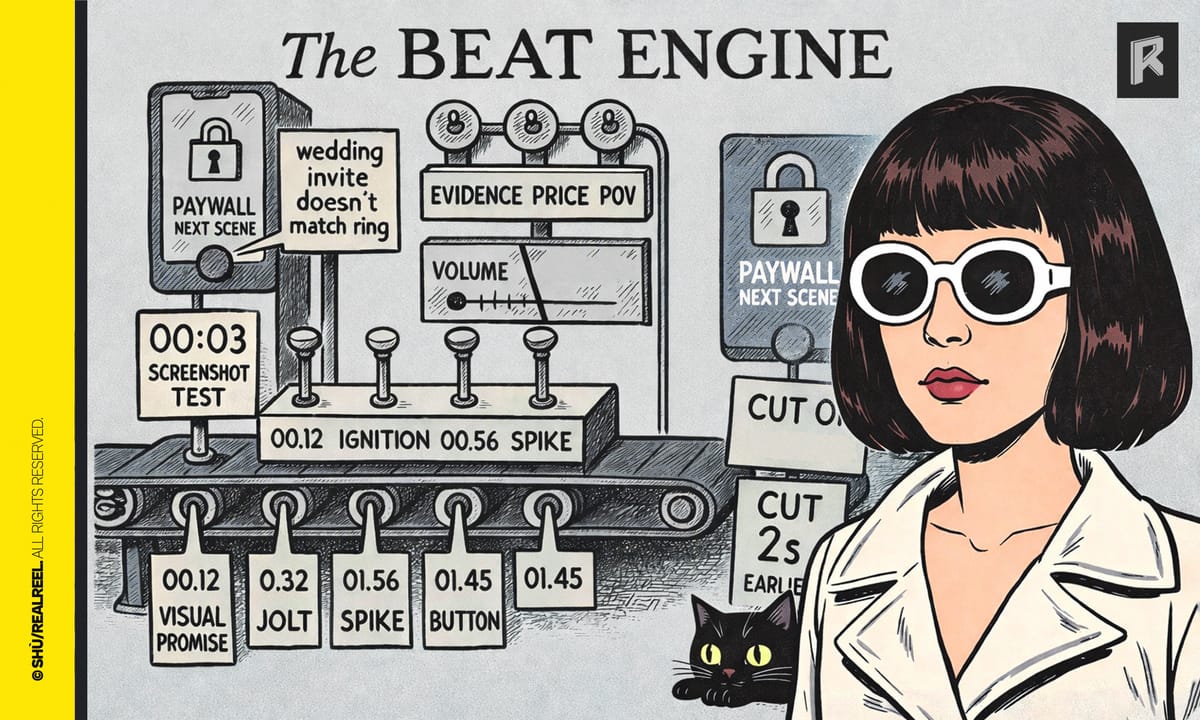
Vertical drama isn’t a mood, it’s a machine. On a phone, attention is a fingertip away from disappearing, so your episode has to create momentum you can see, not just feel. That means designing for frames, timestamps, and proof.
This first part focuses on two layers: the opening and the single-episode circuit. It’s built for writers, directors, and editors who need workbench rules they can shoot, cut, and A/B tomorrow.
The first three seconds: a visual contract
You don’t “ease into” a vertical story. You announce it. Your first three seconds should deliver, without dialogue:
- Premise signal (what arena we’re in),
- Immediate pressure (why this matters now),
- Readable image (a stranger can describe it in six words).
Screenshot test: freeze-frame at 00:03 and ask a friend to summarize in one sentence. If they need backstory, you’re not there yet.
Shootable examples
- A groom’s boutonniere stabbing a non-matching wedding invite — two rings, one date.
- A nurse peeling back tape: a hospital bracelet with the wrong name.
- A cracked phone in rice, still ringing, caller ID says “HR Legal.”
No narration, no backstory. A visual promise.
0–15s ignition: do something you can’t undo
Ignition is the first non-reversible beat: a reveal, a public move, a choice with cost. It’s not a feeling, it’s evidence on camera.
- Good: She posts the photo in the company Slack.
- Weak: She says, “I’m done being quiet.”
Ask: What, if filmed, would change the available options for these characters right now? That’s ignition.
The 20–40 second pulse: plan the jolt
Healthy vertical episodes breathe at a pulse of roughly every 20–40 seconds. Not noise — information with force. Design the jolts before you write dialogue.
Three jolts that matter
- Evidence shift: a receipt, location ping, badge swipe, live screen record.
- Price hike: the pursuit now costs more (status, money, freedom, love).
- POV flip: the frame reveals we misread who had power or what a symbol meant.
If the jolt disappears when you mute the audio, it wasn’t a jolt. It was volume.
Build the episode as a circuit
Think in a closed loop you can draw on one line:
Hook → Friction → Spike → Button
- Hook (0–15s): the visual contract + ignition.
- Friction (15–60s): physical or social obstacles you can film — keycards, protocols, “you can’t stand here,” a meeting starting without you.
- Spike (60–90/150s): the largest jolt — evidence/price/POV flip that re-prices the scene.
- Button (last 5–10s): cut on the question, not the answer.
Buttons: end two seconds earlier than feels safe
Most vertical scenes over-explain their cliff. Don’t trail the moment with reaction shots you don’t need. Cut on the inhale. The more precise your button, the cleaner your forward pull.
Sanity check: can a new viewer start at the next episode and immediately see what they missed without a voiceover? That’s a clean button.
Write by timestamps, not scenes
Before sluglines, draft a beat sheet in time. For a 120s ep:
- 00:00 — Visual promise (screenshot test).
- 00:12 — Ignition (non-reversible action).
- 00:32 — Jolt 1 (evidence shift).
- 00:56 — Jolt 2 (price hike).
- 01:18 — Spike (largest re-price).
- 01:45–01:55 — Button (clean cliff, no extra reaction).
Now earn your dialogue to carry those beats, not invent them.
Friction you can film
If your “obstacle” is a speech, you don’t have one. Use:
- Space rules: door codes, badge tiers, “no phones” zones, public vs. private sightlines.
- Status rules: who interrupts whom, who decides when silence ends.
- Clock rules: countdowns visible in-frame (screen recorder, oven timer, meeting ticker).
This keeps conflict embodied, which is where vertical lives.
Don’t confuse volume with velocity
Three common fumbles:
- Shouting ≠ stakes. If options didn’t change, nothing happened.
- Labels ≠ character. “Alpha” is meaningless without signals the camera reads (who holds the hallway, who gets handed the only badge).
- Trivia ≠ twist. Surprise without a new price to pay is a party trick.
If a beat feels soft, add proof, not adjectives.
Quick workbench
- Write a timestamp skeleton for the next episode.
- Draft three potential Hooks and A/B them with your team; keep the one that survives the screenshot test.
- Place two minor jolts + one spike on the skeleton before dialogue.
- Identify filmable friction (space/status/clock).
- Cut a Button that lands on a question tied to cost.
Build it like you’ll have to reshoot tomorrow. When the beats are visible, you can swap lines, move moments, and still keep the current running.