Vertical Drama Review: Goodbye My Tempting Wife


⚈ ⚈
A Gender-Flipped Fever Dream You Can’t Look Away From
Apparently you all enjoyed my last meltdown, so yes, Amy is back.
Join Real ReelToday we’re reviewing NetShort’s charting title, Goodbye My Tempting Wife.
On paper it looks like a switch-up: a male protagonist, a corporate backdrop, the promise of something slightly less soap and more “grown-up.” In practice, it plays like a gender-flipped spin on the usual secret-heir melodrama: a husband pushed out of his own family while a CFO groomed “other man” angles his way into both the marriage and the C-suite. We’ll look at what creators can steal from its engine in a second, but first… snark mode on.

According to IMDb, the lead’s a working SAG actor with multiple credits across indie features and U.S. television, and it shows. He sells the opening heartbreak cleanly: the shock, the pleading, the sense that the ground just dropped out from under him. The problem is that the writing turns his pain into something oddly adorable. I caught myself laughing during a scene that clearly wanted me to ache for him, not because he’s bad, but because the performance is so earnest it loops back into “protect this man at all costs” meme territory.
The plot, though, lives on a different planet. A company’s CFO helps the wife leapfrog into the COO role. On that basis alone, she’s ready to divorce the husband she’s lived with for years. The CFO pushes the breakup like it’s his quarterly OKR. Their kids cheer it on because one already works under the CFO, and the other’s boyfriend might be hired there. This isn’t corporate drama; it’s job-market horror fanfic. You almost expect a lower-third chryon: “Sponsored by Unemployment Anxiety.”
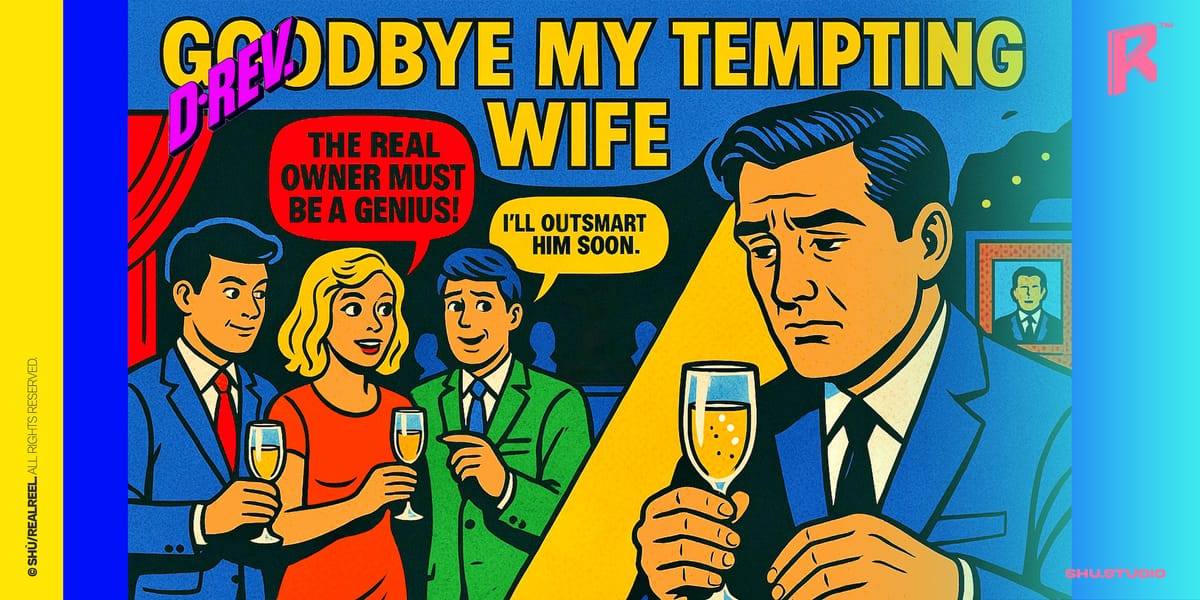
Then comes the gala. There is always a gala. The wife, the CFO, and the kids (still unclear why they’re at a corporate gala instead of in bed or on TikTok) stand around talking about the mysterious true owner of the company, sneering, guessing, underestimating. The husband, who is, of course, the real major shareholder, drifts through the frame as set dressing while everyone monologues about how insignificant he is. It echoes scenes we’ve seen in Miss You After Goodbye, Heiress Crash Lands on Her Husband, Kissed by Fire, Never Divorce a Secret Billionaire Heiress: a room full of people, a hidden rich identity, and a script that refuses to let anyone connect two very obvious dots.
By the third loop of “he can’t possibly be the boss” → partial reveal → fresh denial, I was deep into that familiar vertical-drama state: annoyed, entertained, and mildly worried about myself for not turning it off.
Okay, spoiler pass complete. Let’s put on our creator hats and take a closer, professional look at how this show works.

Industry & craft, in one pass
On NetShort, Goodbye My Tempting Wife sits cleanly in the Hidden Identity / corporate–family melodrama lane and plays out over a mid-length episode grid built for a humiliation–reveal treadmill: domestic expulsion → workplace disrespect → public gala shaming → delayed identity confirmation, each pass designed to push the thumb one more episode down instead of out of the app.
The primary genre engine is a hybrid of secret-heir drama and divorce melodrama. Instead of mansions and baby heirs, the currency here is control over titles and jobs: COO appointments, reporting lines, “who works for whom” and “whose boyfriend needs this job.” Equity, voting shares, and C-suite labels become the on-screen proxies for power; the show treats them the same way pregnancy romances treat black cards and private jets, not as realistic mechanics, but as visible proof that one person’s status can erase another’s life overnight.
Around that, the show layers a secondary palette that tracks with what’s been testing well in vertical data the last 18 months: inter-generational employment anxiety, kids choosing bosses over parents, class mobility through corporate ladders instead of marriage, and a low-grade fear of being economically replaced inside your own family. Every 60–120 seconds, the narrative either tightens one of those screws (another character siding with the CFO, another scene where the husband is treated as disposable labour) or gestures toward revelation (a hint about the shareholder structure, a near-slip at the gala) only to walk it back and re-arm the misunderstanding loop.
Formally, the show behaves like a vertical drama that knows exactly what it’s selling. Blocking keeps faces, shoulders and nameplates inside the 9:16 safe zone; power is staged front-to-back so the character on higher ground or closer to lens reads as dominant before they say a word. In the office and gala sequences, the cut pattern: two-shot, insert (a badge, a contract, a podium), reaction, resets on a tight clock, giving editors clean hooks for performance ads and clip bundles. The lead works reliably in close-up, toggling between hurt and restrained pride; the wife, CFO and kids are written closer to types than people, but that flatness keeps their function legible in one glance on a phone.
From a business standpoint, this kind of male-led Hidden Identity piece is useful slate glue for a platform like NetShort: it lets them test whether the same misunderstanding–reversal loop that drives heiress romances will travel when you swap in corporate stakes and a dad as the pain carrier. Structurally, each near-reveal, each gala humiliation, and each “you’re nobody here” beat is a natural soft paywall or ad-pod hinge; the show is less about building a believable company than about carving repeatable 90-second modules that can be re-cut, re-targeted, and resold wherever viewers are already doom-scrolling stories of work, money, and betrayal.
★★★☆☆