Playbook: Emotional Patterns by Genre Part 1: What Your Vertical Show Is Really Selling

In vertical drama, audiences are not buying “genres”.
They are buying very specific emotional experiences, on demand, on a small screen.
In our earlier pieces,
we called the basic loop:
Shock
—
something breaks the normal pattern
Hurt
—
a character pays an emotional price
Release
—
the story gives you a payoff that feels worth the pain
This article doesn’t re-teach the loop.
Instead, it asks a simple question:
When you say “this is a romance / revenge / power fantasy / family drama”,
what emotional promise are you making to the audience?
Four genres, four simple questions
If we strip away costumes and settings, most vertical hits on today’s apps keep circling four types of stories.
Each type really
asks
one key question:
- Romance: “Can someone like me ever be chosen, openly, by someone who could choose anyone?”
- Revenge: “If the world has treated me unfairly, will I ever see it forced to pay me back?”
- Power Fantasy: “What if I secretly had a cheat code, while everyone around me thought I was nobody?”
- Family Ethics: “If I’ve carried this family for years, will anyone finally admit it and change how we live?”
On the app store, these all sit under “romance / suspense / family”.
On a phone, they feel totally different, because the emotional question is different.
That question is what your show is really selling.
Think of Shock / Hurt / Release as three dials
Inside a 90-second episode,
Shock / Hurt / Release repeat many times.
The difference between genres is:
Which beat gets turned up the loudest, and for how long?
Very roughly:
- Some genres are Shock-heavy: the main thrill is surprise and reversal.
- Some are Hurt-heavy: the audience stays with the character’s pain for longer.
- Some are Release-heavy: the big pleasure is the payoff: being chosen, winning, getting justice.
If we look at the four common types:
Romance
- Shock: usually small but fast: a breakup, an awkward meet, a sudden contract.
- Hurt: being looked down on, not believed, “not enough”.
- Release: being openly chosen in public.
Revenge
- Shock: life collapses, betrayal, prison, death + rebirth.
- Hurt: long corridors of humiliation and forced silence.
- Release: public payback, often in one big set-piece (wedding, boardroom, courtroom).
Power Fantasy
- Shock: the cheat code appears, a system, a secret, a hidden status.
- Hurt: everyone underestimates you.
- Release: visible control, one decision that quietly flips the whole room.
Family Ethics
- Shock: the family structure breaks, divorce, selling the house, a secret child.
- Hurt: years of unpaid, invisible work ignored.
- Release: recognition and a real change in who has power at home.
You don’t have to follow these patterns 100%.
But your audience has already learned them from thousands of episodes.
If you fight them without a plan, you are asking your show to swim upstream.
Why this matters in development and pitching
When you pitch a new vertical series, it’s easy to fall back on vague language:
“A story about love and healing in the city.”
That tells a reader almost nothing.
If you start from the emotional question, the pitch becomes concrete:
Romance example
“After being dumped on her 30th birthday, a tired nurse is pushed into a fake marriage with the hospital’s new investor. The real question is whether a woman who has been told she’s ‘not enough’ all her life can ever be chosen publicly, on her own terms.”
Revenge example
“A loyal son is framed by his own relatives, loses his freedom and his company, and gets one chance to come back five years earlier. The show keeps asking: will the family that erased him be forced to say his name again, this time with respect?”
These lines are not “slogans”.
They are promises about Shock / Hurt / Release:
- where the big shocks sit
- what kind of hurt the audience is asked to share
- what kind of release they are waiting for
Once that promise is clear, it becomes much easier to:
- decide which scenes are essential, and which are filler
- plan a season around a few non-negotiable payoff episodes
- keep marketing, writers and production on the same emotional track
Four questions to put in every project deck
You don’t need a long theory section.
Four simple lines in your deck are enough:
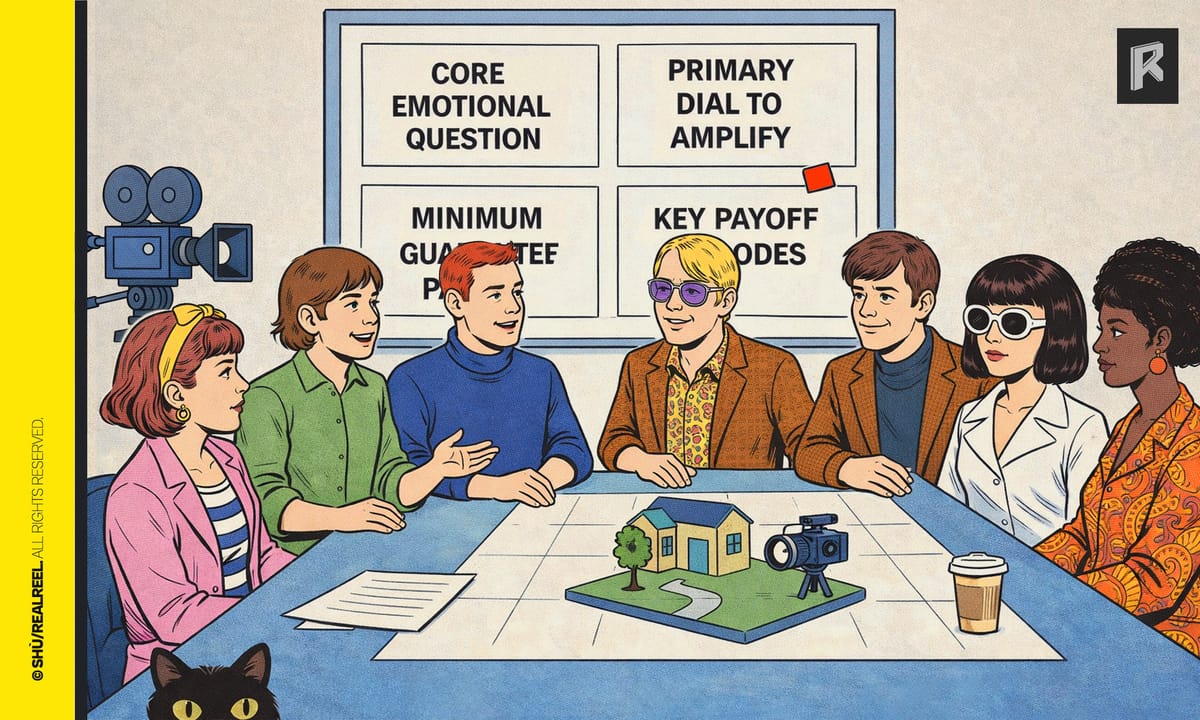
Core emotional question
One sentence, in plain language.
Primary beat to amplify
For this show, which beat is the main “product”? Shock / Hurt / or Release?
Minimum guaranteed payoff
- In what form must the Release arrive for this audience to feel satisfied?
- For example: “public choice”, “public apology”, “visible control”, “change in who decides.”
Key payoff episodes
On which episode numbers do we promise a major Release that answers the core question?
If you can’t answer these, the genre is still a costume, not a tool.
You’re selling “a vibe”, not a clear emotional experience.
Part 2 looks at the same four genres, and breaks down the most common Shock / Hurt / Release patterns you’ll see on the page, with concrete examples you can use as templates.