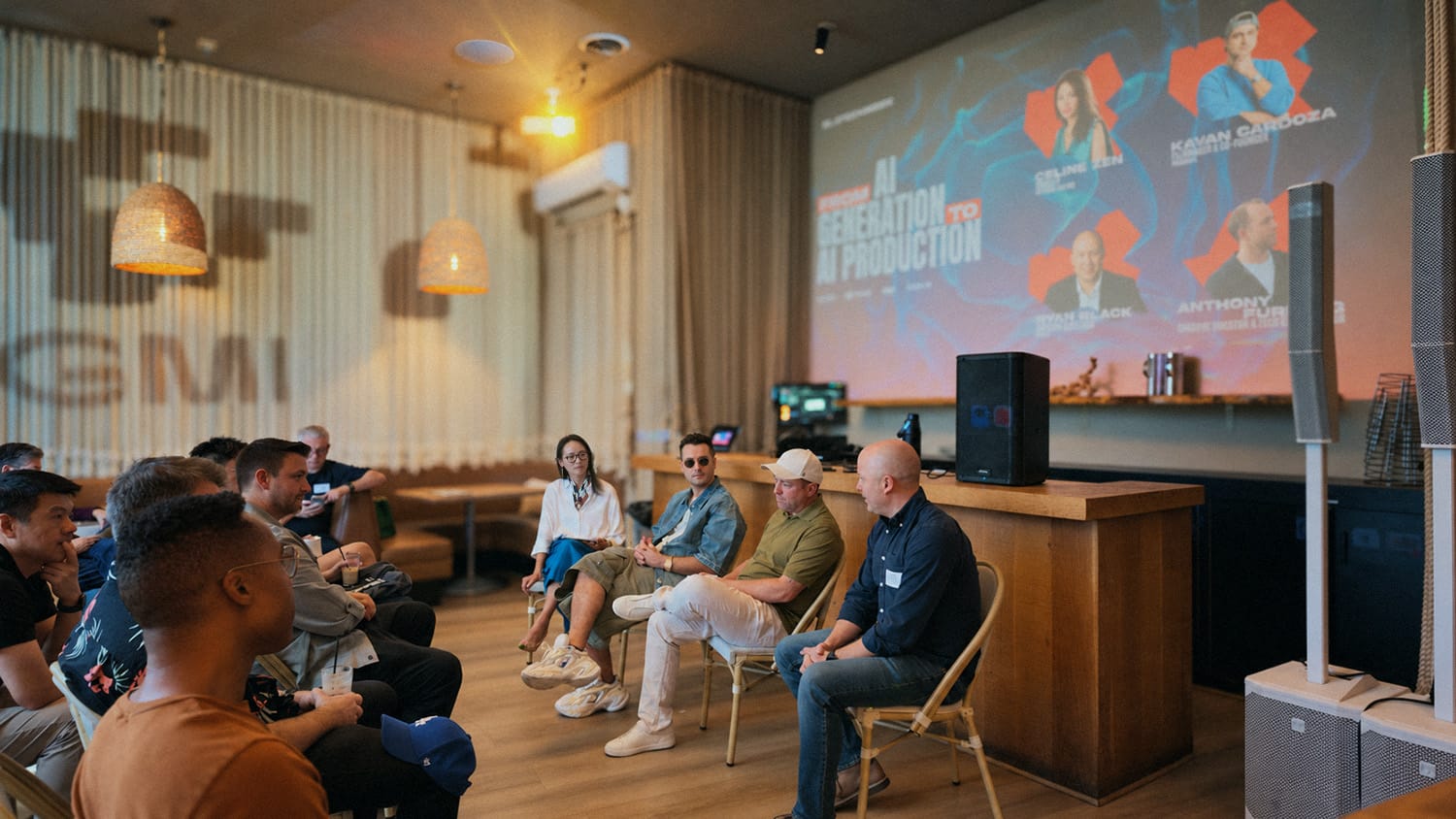
At LA Tech Week, Kavan Cardoza, Anthony Furlong and Luma AI’s Ryan Black explored the practical realities of long-form AI filmmaking, from camera coverage and revisions to production costs, creative control and distribution.

Replacing a Mercedes with a BMW sounds like a minor production note. But what happens when the car appears in an AI-generated scene, and the client wants everything else to remain exactly the same?
That was one of the questions raised by Emmy-winning director Anthony Furlong at “From AI Generation to AI Production — Workflows for Long-Form Storytelling,” a panel held on October 14 during LA Tech Week.
The event brought together GMI Cloud, NVIDIA, SHÙ Studio and Real Reel, with SHÙ Studio founder and producer Celine Zen moderating a conversation featuring Kavan Cardoza, AI filmmaker and co-founder of Phantom X; Anthony Furlong, a DGA director and production technologist; and Ryan Black of Luma AI, who previously spent 14 years at Lionsgate working across acquisitions, development and production.
The discussion began with a familiar challenge in generative filmmaking: consistency. But it quickly moved beyond keeping a character's face or an environment visually stable. The panelists explored what happens when AI-generated footage has to survive the demands of actual production: revisions, camera coverage, performance, editing, team approvals and budgets.
Their experiences suggested that some of the challenges associated with AI filmmaking are becoming easier, while others only become apparent once a project moves beyond individual shots.
Consistency Is No Longer Just a Visual Problem
For Kavan, visual consistency is becoming much less difficult than it was even a year or two ago.
Working on his fully generative dark fantasy series The Chronicles of Bone, a Magnific Original Series, he uses established character references and visual assets to maintain recognizable designs across scenes. Improvements in image-generation tools have made that process significantly more manageable.
Anthony approached consistency from another direction.
His Mercedes-to-BMW example was about what happens after a shot has already been generated and approved. A client may want one object changed, one costume altered or one detail corrected across an entire sequence. Can those changes be made without disturbing everything else?
That requirement becomes especially important when a production involves clients, producers or studio executives who need to review and approve material.
“You have to have trust within the system,” Anthony said, referring to the need for predictable results within a production's schedule and budget.
Ryan pointed to Luma AI's layer-based editing and camera and lighting controls as developments aimed at making these adjustments more precise. He also discussed EXR and HDR output, which can help AI-generated footage enter established post-production and color-finishing workflows.
The exchange exposed a useful distinction.
Visual consistency concerns whether characters, environments and objects remain recognizable across generated footage. Production consistency adds another requirement: whether filmmakers can preserve approved creative decisions while making specific changes.
Kavan's experience shows how far the first problem has progressed. Anthony's example illustrates why the second remains critical in professional production.
The Hidden Work Behind AI-Generated Footage
Kavan's workflow offered a closer look at what goes into turning generated footage into a continuous narrative.
For The Chronicles of Bone, he described photographing character references in simple costumes before using AI to develop the final stylized designs. These references help establish a recognizable visual identity before the characters appear across multiple scenes.
Camera coverage requires another layer of preparation.
Kavan explained how he can generate different views of a scene, including a rotation around the environment, and use the resulting frames to help plan additional camera angles. He then works toward fresh, higher-quality image outputs rather than repeatedly relying on video screenshots as source material, which can introduce degradation.
The purpose is familiar to anyone who has planned coverage for a live-action scene: establish where the characters are, which direction they face and how the camera moves through the space.
The difference is that these decisions must be translated into references and generation instructions before the footage can be assembled.
Kavan described generating several versions of a sequence, watching the results and selecting usable moments from different outputs.
A generation may contain only a few seconds worth keeping, even when the requested clip is considerably longer.
He also discussed how the intended edit affects the way he generates shots. Dialogue length, pauses, character interactions and the expected cutting point all need to be considered before committing to a generation.
In some situations, generating interacting characters together can produce more convincing emotional exchanges than creating each character's individual performance separately. But longer generations can also produce unnecessary footage and higher costs.
Action sequences are particularly demanding. The more complicated the movement and interactions, the more attempts and editorial work may be needed to obtain a coherent result.
These details complicate the assumption that faster image generation necessarily means faster filmmaking.
AI can reduce or eliminate certain physical production requirements, but work remains between generating footage and obtaining a finished sequence. That work includes scene planning, selecting takes, correcting results and assembling material into an edit.
The relevant measure of efficiency may therefore be less about the cost or speed of a single generation than about the resources required to produce footage that actually makes it into the final film.
Anthony raised a related issue for larger teams.
When a director is working alone, creative decisions can be made and changed immediately. With producers, department heads and other collaborators involved, the process also needs shared references and approval points.
He discussed using animatics and previsualization to establish what a scene should look like before moving deeper into production.
In other words, AI changes how images are created, but it does not automatically eliminate the coordination required to make a film.
One Creator or an Entire Film Crew?
The question of collaboration produced one of the panel's more revealing differences in perspective.
Anthony spoke about the value of having actors, cinematographers, production designers and other specialists involved in filmmaking.
Beyond their technical contributions, collaborators can introduce ideas that a director had not anticipated.
He distinguished between generating an image and the creative exchanges through which a film develops.
Kavan disagreed with the implication that a substantial team would always be necessary.
After years making music videos and commercials, he had struggled to get ambitious narrative ideas considered within the traditional studio system. Generative AI gave him a way to create work on a scale previously beyond his available resources.
With The Chronicles of Bone, he handles the creative production himself while building an audience through YouTube.
He called this opportunity the “dawn of the storyteller.”
Kavan was not suggesting that anyone with access to a model automatically becomes a filmmaker. His own directing and editing experience remains essential to his process. But AI has changed how much of that process one person can execute.
Ryan described a different production path through hybrid filmmaking, where live-action performances, physical sets and established crews operate alongside generative technology.
Rather than producing every element synthetically, hybrid projects can use AI to extend environments, modify footage or achieve sequences that would otherwise require more extensive physical production.
These approaches raise a practical question for filmmakers and producers: how much of the traditional production structure does a particular project actually need?
For a creator developing and controlling an original series independently, a compact AI-native workflow may offer considerable freedom.
For a studio-scale project involving multiple creative departments, financiers and approvals, production infrastructure still serves important purposes. AI may change the work assigned to those departments, but coordinating decisions remains necessary.
The panel did not establish that one model would replace the other. It showed how different production requirements are already producing different uses of the same technology.
Lower Production Barriers Do Not Remove Business Risks
Ryan recalled how traditional production budgets could reshape a screenplay before cameras rolled.
During his years at Lionsgate, a budget reduction might mean removing a scene, reducing shooting days or replacing an expensive car chase with a more affordable foot chase.
Generative tools offer another way to approach those decisions. A sequence that once required locations, large crews or extensive visual effects work may become achievable through a combination of physical production and AI.
That changes which ideas can realistically be considered, especially for filmmakers working outside major studio budgets.
Kavan's experience shows another possibility: creators can begin producing original IP and building an audience without first securing a conventional studio greenlight.
But producing independently is not the same as financing a production alone, nor does AI-native filmmaking mean that production costs disappear.
The Chronicles of Bone is supported by Magnific, and Cardoza's account of the work made clear that substantial generation and editorial resources can still be required. Complex action, repeated attempts and longer outputs can all increase costs.
The distinction matters. AI may reduce dependence on certain physical production resources while introducing a different mix of expenses, including computing, generation, technical expertise and extensive iteration.
Distribution creates a separate challenge.
During the audience Q&A, Kavan emphasized two priorities: maintaining creative control and getting paid for the work.
He did not identify a single ideal distribution platform. Instead, he argued that the right channel depends on the kind of content being produced and where its audience can be found.
This was particularly relevant to a creator who has built a following through YouTube while developing original narrative IP.
Lower production barriers may allow more filmmakers to create ambitious work, but that also makes audience development, ownership and sustainable revenue increasingly important.
A creator may now be able to make a series that would once have required a much larger organization. Finding enough viewers to support the next season is another problem entirely.
Where the Tools Still Fall Short
Despite his enthusiasm for fully generative filmmaking, Kavan identified synthetic acting as one of the areas that still needs substantial improvement.
Visual quality has advanced rapidly, but a convincing performance involves more than a recognizable face delivering dialogue.
An actor can alter a scene through an unexpected pause, a different inflection or a gesture the director never planned. Kavan described these spontaneous choices as part of what makes working with real performers valuable.
Anthony similarly emphasized the creative contributions that emerge from collaboration, suggesting that the value of actors and other filmmaking professionals extends beyond tasks that can be reproduced technically.
Writing presents another limitation.
Kavan uses AI to keep track of the numerous characters and intersecting storylines in The Chronicles of Bone. It helps him remember where characters last appeared, organize narrative threads and maintain continuity across episodes.
He was much less convinced by AI-generated dramatic writing, particularly dialogue that relies on exposition rather than character or subtext.
The distinction is significant for long-form production: AI can help manage an increasingly complicated story world without necessarily being responsible for creating the story itself.
For Anthony, one of the most desirable improvements is real-time creative responsiveness.
He imagined watching a scene, asking for an overhead shot or reverse angle, and seeing the result quickly enough to make another creative decision immediately.
That would move generative tools closer to a director's working process, where experimentation and revision happen continuously.
Other priorities raised during the panel included higher native resolution, more flexible color grading and improved integration with established production tools.
The conversation also turned to the kinds of stories audiences may seek as synthetic imagery becomes more common.
Anthony wondered whether an abundance of artificial images could generate renewed interest in intimate, performance-driven films. Kavan argued that technically sophisticated images and large-scale spectacles would continue to have an audience, but the emotional effectiveness of the story would remain essential.
The two perspectives pointed toward a similar uncertainty: greater access to image-making technology does not automatically determine what viewers will value.
Beyond the AI Label
Near the end of the panel, Ryan described a milestone he hopes the industry will eventually reach: the point when audiences stop treating a film's use of AI as its defining feature and simply experience it as “a movie.”
For that to happen, generative technology must become dependable enough to serve the production rather than dominate the conversation around it.
The panel offered several indications of where that transition is already happening. Character consistency is improving, creators are developing full narrative series with compact production setups, and hybrid workflows are bringing AI into more established filmmaking processes.
At the same time, professional revisions, complex performances, multi-person approvals and sustainable production economics remain demanding.
The growing ability to generate footage may be changing who gets to make films and what they can afford to put on screen. The next test is whether those new production methods can consistently deliver work that audiences want to watch — and that filmmakers can afford to keep making.
Further Reading
The Quiet Takeover: How AI Is Rewriting the Short Drama Playbook — A closer look at how AI-generated storytelling is moving beyond production experiments and into established distribution pipelines.
 Real Reel

The Infrastructure Week: AI Quietly Took Over Vertical Production — A look at AI moving beyond individual production tools and into the infrastructure, platforms and workflows underneath content production — the shift this panel was already confronting in practice.
 Real Reel
✱