This week, mobile-first entertainment started revealing more than growth. The economics behind the format, from revenue and measurement to labor and brand risk, are becoming much harder to ignore.
⦿⦿
Mobile-first entertainment is no longer just proving demand. It is starting to reveal the economics-and the consequences-behind the format.
Week of Sep 08-Sep 13, 2026
Mobile-first entertainment showed more of its underlying economics this week as Pocket Entertainment reported new AI-driven revenue, The Hollywood Reporter introduced a dedicated microdrama chart, and AI production continued reshaping Hollywood's vertical-drama workforce. Meanwhile, LoveHit tested dual-format production, FlareFlow expanded microdramas to connected TV, and branded storytelling brought new opportunities, and risks, for companies entering scripted entertainment.
AI starts reshaping Hollywood's microdrama workforce
The Hollywood Reporter documented a sharp slowdown across Los Angeles' live-action microdrama production ecosystem this week, as platforms increasingly experiment with AI-generated series. Talent manager Maddie Grove said casting breakdowns had fallen from roughly 15–20 vertical productions a day before June to around four, while actor Kylie Karson said her weekly vertical auditions had dropped from as many as 15 to around two.
The economics help explain the shift. THR reported live-action microdramas typically cost around $100,000–$300,000, while professional AI productions can fall closer to $60,000–$100,000. Shortical CEO Guy Shimoni estimated that a production that once required around 50 workers could now be completed with five.
For a format that became an employment lifeline after Hollywood's strikes, AI is no longer a future production question. Its labor impact is already becoming visible.
Microdrama may be one of the first entertainment sectors where AI production economics reshape the workforce in real time.
 Katie Kilkenny
Pocket Saga puts a revenue number on AI-native entertainment
Pocket Entertainment announced that its annualized revenue run rate has surpassed $500 million, up 70% year over year, driven primarily by Pocket FM. But the more revealing number for mobile-first video comes from Pocket Saga, its three-month-old U.S. microdrama app. CEO Rohan Nayak told TechCrunch that Pocket Saga has already reached roughly $15 million in annualized revenue.
Unlike Pocket FM, where humans remain involved in story development, Pocket Saga's current video catalogue is entirely AI-produced. The company is also converting successful Pocket FM audio stories into AI-generated video without passing through traditional live-action production.
That makes Pocket Saga one of the clearest early tests of whether AI-native entertainment can generate consumer revenue—not simply reduce production costs.
AI-native entertainment is starting to produce revenue data, not just production demos.
 Jagmeet Singh
LoveHit designs the same IP for vertical and horizontal screens
One important launch from last weekend is worth catching up on. Los Angeles-based LoveHit is entering the market with adaptations of public-domain literary classics including Wuthering Heights, Pride and Prejudice, Jane Eyre, The Great Gatsby and Beauty and the Beast, with actors including Eric Roberts.
What makes the model more interesting than another microdrama app is what happens beyond the phone. LoveHit is developing its literary properties for vertical consumption while also creating traditional horizontal versions that can travel into television and streaming distribution, with the company planning to take projects to MIPCOM.
That changes the role of vertical: rather than being the final format, it can become one version of a larger IP asset designed to move between screens and buyers.
Vertical is beginning to function as one window for an IP, rather than the end of its journey.
 Jesse Whittock
Microdrama gets its own industry chart
The Hollywood Reporter has launched a dedicated Microdrama Chart, powered by research firm Owl & Co.'s Vertical Index. According to Owl & Co. founder Hernan Lopez, the underlying measurement system tracks more than 70,000 titles across 20 apps every day, monitoring catalogue performance and audience demand across platforms.
The significance goes beyond another top-ten list. Vertical drama has largely been measured through disconnected app rankings, company claims and individual view counts, making meaningful comparisons difficult. A recurring industry chart begins to create a common competitive language around the category.
Streaming had Nielsen. The box office has Comscore. As microdrama matures, measurement itself is becoming part of the industry's infrastructure.
A format becomes an industry when its performance can be measured against itself.
 Brad Hill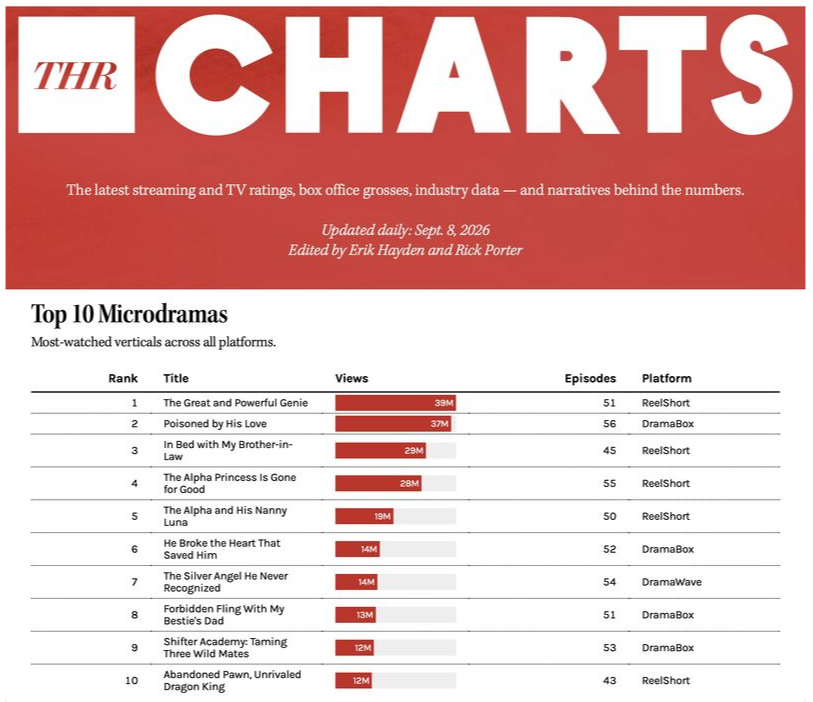
Upscale turns microdrama into an IP development pipeline
Upscale Media Films formally launched this week as a full-service microdrama production company built around a different kind of pipeline. Founder and CEO Malik Davis is acquiring published book properties, pairing them with a standing production team, and handling development, casting, shooting, editing and delivery in-house.
The model is already being used for Hartbeat's slate for aTwist, including adaptations of Blake Karrington's novels. But the vertical versions are not necessarily the endpoint: each project can later be evaluated for expansion into a feature film or traditional television series. Upscale is also producing original material through a hybrid AI-assisted workflow.
The strategy treats microdrama as a relatively lean way to activate existing audiences and test IP before committing to larger formats.
Microdrama is becoming an IP development layer, not just a distribution format.
 Jesse Whittock
Grab learns what happens when a brand becomes a studio
Grab Singapore apologized this week after its first branded microdrama, I Fell In Love With My Grab Driver, drew criticism over its depiction of a romance between a driver and passenger. The company acknowledged on September 8 that it should have been more thoughtful about how the premise could be interpreted, particularly around professional boundaries and passenger safety.
The controversy arrives as brands increasingly experiment with serialized mobile storytelling instead of conventional advertising. That creates new creative opportunities, but Grab's experience also exposes the other side of the model: once a company commissions narrative entertainment, story choices can create risks that a 30-second ad may never encounter.
Branded microdrama is beginning to inherit the responsibilities of the entertainment it imitates.
When brands become studios, they inherit studio problems too.
 A’bidah Zaid Shirbeeni
FlareFlow takes mobile-born entertainment back to the TV
COL Group's FlareFlow launched on Whale TV-enabled televisions across South America this week, bringing a catalogue built primarily around mobile microdramas onto connected television screens. Whale TV says FlareFlow has surpassed 52 million registered users, carries nearly 7,000 titles, and reaches more than 200 countries and regions.
The Chinese-language announcement adds another revealing number: more than 1,200 AI microdramas are already available on FlareFlow, including AI animation and synthetic live-action-style productions.
For years, the industry conversation centered on adapting television for phones. FlareFlow suggests the traffic is beginning to move both ways: content born inside mobile-first ecosystems can now travel back onto the biggest screen in the home.
Mobile-first entertainment is beginning to outgrow the mobile screen. ↗
Tata Motors puts the brand inside the microdrama
India's BULLET Microdrama partnered with Tata Motors Commercial Vehicles on Apna Superstar, a scripted microdrama starring Naman Arora and Nishi Saxena. Rather than placing a conventional commercial around the series, the Tata Azura vehicle is written directly into the protagonist's journey as he tries to build a business and pursue his ambitions.
The project follows BULLET's earlier branded storytelling work with JK Cement and offers another sign that microdrama is becoming a commissionable advertising product in India, rather than simply a consumer entertainment category.
Coming in the same week as Grab's controversy, it also shows both sides of branded scripted entertainment: the opportunity to build deeper narrative integration—and the responsibility that comes with controlling the story.
Brands are moving from advertising around mobile entertainment to financing the story itself.
 Neel Achary
This Week's Take
Last week's developments showed companies beginning to build permanent businesses around mobile-first entertainment.
This week started to reveal what those businesses actually look like once they begin operating at scale.
AI can lower production costs—but it can also remove live-action jobs. A new microdrama app can generate revenue—but now investors can start asking how much. A growing format eventually needs measurement. Brands commissioning entertainment inherit editorial risk. And IP developed for phones increasingly needs a path beyond the phone.
The common thread is not simply that mobile-first entertainment is growing.
It is that the industry around it is becoming specific enough to measure: production costs, revenue, labor, audience demand, IP value, advertising models and distribution windows are all beginning to acquire real numbers and real consequences.
The next phase of mobile-first entertainment will be defined less by whether the format grows—and more by who captures the value when it does.
Further Reading
How Vertical Drama Makes Money — A breakdown of the IAP, subscription and episode-unlock models behind microdrama, useful context as this week's Pocket Saga numbers make the economics of AI-native entertainment more visible.
 Real Reel
AI Is Rewriting the Vertical Short Drama Industry — An earlier structural look at how AI-generated microdramas are moving from production experiments into real distribution pipelines, providing context for this week's new revenue and labor data.
 Real Reel
✱