A line producer with 20 microdrama productions breaks down every major cost category, and explains why the numbers almost never land where first-time producers expect them to.
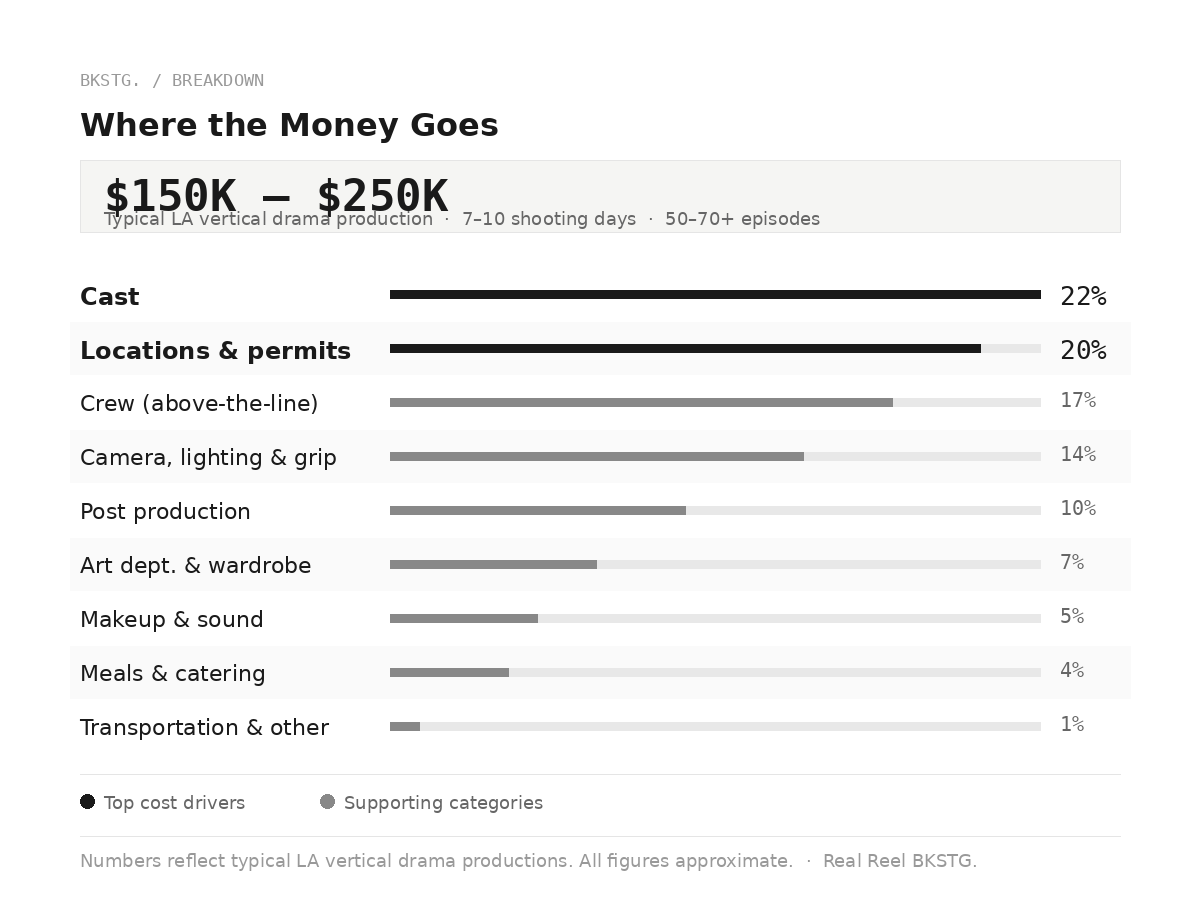
A vertical drama production in Los Angeles typically costs between $150,000 and $250,000 for a 7–10 day shoot producing 50–70+ episodes. The largest cost categories are cast (22%), locations (20%), and above-the-line crew (17%). Location rental and cast, especially experienced leads, are the two line items that drive the most variance between projects.
After producing more than 20 vertical drama and microdrama projects, I've sat across from enough producers and first-time clients to know that a budget is never just a financial document. It's a map of every assumption a production is making, about what the story requires, what the market demands, and what can realistically be executed in the time available.
What follows is what a real LA vertical drama budget looks like. Not a template. Not a best-case scenario. This is the shape of where the money goes, and why.
$150K–$250K
Typical total budget for a vertical drama shoot in LA
7-10 shooting days
55–85 episodes
Above and below-the-line combined
Join Real Reel
The range is wide because the variables are real.
Some short drama series have only 50 episodes, some have more than 70.
A story requiring three luxury locations and an intimacy-heavy cast will sit at the upper end.
A tighter story with fewer location moves and a smaller supporting cast can come in closer to the floor.
But within this format and this market, there is a baseline cost structure that doesn't move much regardless of how lean you try to run it.
Locations: the most visible spend in a vertical drama budget
Experienced producers who know the microdrama format understand immediately when they see the location line: this is where the money shows up on screen. A luxury house that reads wealthy, a penthouse that doesn't look rented, a corporate space that communicates power, these aren't decorative choices, they're genre requirements. Vertical drama runs on status and desire, and the audience makes a judgment in the first two seconds of episode one. The location is doing most of that work.
In LA, a convincing luxury house runs $6,000–$10,000 for a block of shooting days. A typical short drama project needs two or three distinct spaces, plus specialty locations: hospital, police station, upscale bar, public spaces for scenes where everything goes visible. None of them are free, and the location budget reflects all of it.
But location cost is only half the story. Location is also the center of the entire shooting schedule. With only 7–10 days to shoot 50–70+ episodes, the production goal is to minimize company moves. Every time a crew of thirty-plus packs up and relocates, you lose time that can't be recovered. A well-built schedule groups scenes by location rather than story order, you shoot everything that takes place in the estate before moving to the hospital, regardless of where those scenes fall in the narrative. The script runs in story order; the shoot runs by geography. Managing that tension is what the 1st AD and line producer do together from day one of prep.
For producers seeing this number for the first time, the question is usually: why so much? For producers who've been through the process, the question is: is this the right house? Both are the right question.
"Location is the one line item where clients can see exactly what they're getting. That makes it easier to explain, and easier to get right."
Cast: two structures, one consistent pressure
Vertical drama and microdrama cast structures tend to fall into one of two models, and which one you're working with changes how the budget distributes.
The first is an ensemble model: a large number of supporting characters each generating conflict for the leads. More roles, fewer days per person, a more complex scheduling puzzle. The second concentrates the drama: a second male and second female lead who are present throughout almost the entire shoot, functioning as the primary antagonists or complicating forces. In this case, supporting roles are fewer, but the second leads are effectively full-duration cast members.
In either model, the leads are where the majority of cast spend goes. Experienced clients already know this: the male and female leads with the right profile and a proven track record are the primary investment. Lead rates in the current LA market vary significantly, but the market has stabilized enough that an experienced producer can read the range with reasonable accuracy. What's consistent is that the leads command the largest share of the cast budget, and building around the wrong cast at the wrong price is one of the most common budget mistakes on a first microdrama production.
Supporting cast rates typically run $350–$700/day depending on role size and experience. Day players run around $250. Then there's background, and vertical drama genuinely needs it.
Party scenes are practically a genre convention in short drama. Public humiliation, public reversals, the crowd witnessing the moment everything changes — these are structural beats the audience expects. Some productions have three or four party sequences accounting for a significant share of total episode count. Each one needs background. LA has a deep talent pool, which helps on price and selection, but thirty or forty people per party scene across multiple shooting days adds up and needs to be in the budget from the start.
One line item we always include: an intimacy coordinator. The genre is romance-driven, and intimate scenes are structural: the cliffhangers, the payoff moments. Having a coordinator on set protects both performers and the schedule. A scene that stalls costs hours the production can't afford. At the rates they work for, it's inexpensive insurance.
Camera and equipment: built for pace
The standard vertical drama camera department: cinematographer, camera operator, first AC, gaffer, key grip, runs 10–15 pages of script per day across a 7–10 day schedule. That pace is only possible with preparation and the right equipment decisions.
Most LA microdrama productions shoot with two cameras simultaneously, closer to multi-camera television than single-camera film. Two cameras means covering two angles at once, typically a master and a close-up, which is the only way to maintain coverage at the page rate the schedule demands. It also means a slightly larger camera department and a more complex on-set workflow, but the alternative is falling behind, and falling behind on a vertical drama schedule is expensive in a way that's hard to recover from.
Sony's Cinema Line has become the default for this format. The FX3 and FX6 are the workhorses: compact, lightweight, full-frame sensors with wide ISO ranges that hold image quality across mixed and low-light conditions. On a schedule this compressed, there's no time to light every setup from scratch. Cameras that can adapt to existing light give the DP flexibility to move quickly. The FX3 in particular works well for vertical drama, small enough for handheld operation without additional rigging, and capable enough to match the FX6 in most shooting conditions.
BTS coverage, a dedicated behind-the-scenes cinematographer and stills photographer, should be budgeted from the start, not treated as optional. The promotional materials, the platform content, the social presence that builds an audience before launch: it all comes from footage and stills captured during the shoot. It cannot be recreated after the fact.
Pre-production: flat fees, clear scope
One aspect of vertical drama and microdrama budgeting that producers outside the format often don't know: a significant portion of prep work is paid as a flat fee rather than a day rate. This applies to key prep roles including the 1st AD, art department, and costume department.
The logic is practical on both sides. Production knows the cost upfront. The crew member knows the scope and can organize their time accordingly. The short drama format has industrialized enough that the prep workflow, location scouts, breakdown, schedule build, prop sourcing, wardrobe assembly, is well understood, and a flat fee reflects that more honestly than a day rate for work that doesn't map cleanly to shooting days.
On the art department and wardrobe side, another factor that meaningfully reduces costs: experienced crew in this format often carry their own inventory. A costume supervisor who has been doing vertical drama for several years has built a wardrobe collection that can dress a production at a fraction of what rental alone would cost. Same with props. This doesn't appear as a line item, it shows up as a lower-than-expected art and wardrobe spend, and it's only available when working with crew who have been in the format long enough to have built that infrastructure.
Post production: the least controllable phase
Post runs around 10% of total budget, and it's the most variable phase of any microdrama production, not because post is inherently complex, but because it's where every unresolved problem from the shoot surfaces.
Some platforms handle their own editing once they receive the footage, which simplifies the production company's role at this stage. When the production company is cutting, the process is more involved. A shot missed on set, audio not captured cleanly, a scene that needs pickups to cut properly, all of these change the timeline. Client revision rounds vary. Deliverable specifications vary by platform. The full scope of post is not knowable at the start of a project the way the shoot schedule is.
What contains the risk is that by the time post starts, physical production is over. Overruns here are real, but they don't trigger the cascade of crew, location, and equipment costs that a shoot day going over budget creates. A lean, skilled post team working with organized footage from a well-run shoot can hold the line. The productions that struggle in post are almost always the ones that carried unresolved problems through the shoot.
What this means for the line producer
Compared to a conventional drama production, a vertical drama is a different kind of pressure on a line producer. The contingency budget, the margin for unforeseen costs, is minimal. There is almost no financial cushion for things going wrong on set. One day behind schedule, and the entire production risks going over budget. That's a situation no production company wants, and no platform wants to hear about.
Which means the real work happens before the shoot. The schedule has to be built to actually hold. Locations have to be locked to minimize moves. Cast has to be prepared. The crew has to understand the plan well enough to execute without being told twice.
The three people who make or break a vertical drama shoot are the line producer, the director, and the 1st AD. When those three are aligned: on the schedule, on priorities, on what happens when something doesn't go to plan, productions run on time and on budget. When they're not, the contingency runs out before the problems do.
"There's almost no margin for error on a vertical drama shoot. The budget forces you to get everything right before it starts, because on set, there's no time to fix it."
FAQ: vertical drama production costs
How much does it cost to produce a vertical drama in the US?
A vertical drama production in Los Angeles typically runs between $150,000 and $250,000 for a 7–10 day shoot producing 50–70+ episodes. The range varies based on cast profile, number of locations, and episode count. Productions requiring multiple luxury locations and experienced leads with market recognition will sit at the higher end.
What is the biggest cost in a vertical drama production budget?
Cast and locations are consistently the two largest cost categories, together accounting for roughly 40–42% of total budget. Cast is driven primarily by lead actor rates. Locations are driven by the genre's visual requirements: luxury houses and specialty spaces (hospital, police station, bar) are structural to most vertical drama stories and cannot be substituted cheaply in the LA market.
How long does it take to shoot a vertical drama series?
Most vertical drama productions in LA shoot in 7–10 days. During that time, a production typically covers 10–15 script pages per day using two cameras simultaneously. Minimizing location moves is a central scheduling priority, the fewer company moves per shoot, the more efficiently those days are used.
How does vertical drama post production work?
Post production on a vertical drama typically runs around 10% of total budget and is handled by a small team, often one editor across the full episode count, a colorist, and a sound mixer. Some platforms handle editing themselves after receiving footage; others require the production company to deliver cut episodes. Post is the least predictable phase because it surfaces any unresolved problems from the shoot: missing shots, audio issues, and client revision rounds all affect the timeline.
What cameras are used in vertical drama production?
Sony's Cinema Line is the dominant choice for LA vertical drama productions. The FX3 and FX6 are the most common, valued for their compact form factor, wide ISO range, and adaptability to mixed lighting conditions. Most productions run two cameras simultaneously to maintain coverage at the page rates the schedule demands.
Is vertical drama production different from conventional TV production?
Significantly. The contingency budget on a vertical drama is minimal, there is almost no financial cushion for on-set problems. One lost day can push an entire production over budget. This places much greater pressure on pre-production: the schedule, location plan, and crew alignment have to be locked and workable before shooting begins. The line producer, director, and 1st AD relationship is more critical on a vertical drama shoot than on most conventional productions.
Related reading:
 Real Reel
 Real Reel