Vertical Drama vs Traditional TV: Two Different Systems, Not Two Different Lengths
Vertical drama isn't short TV, it's a different system entirely. A breakdown of how pacing, hook structure, character logic and production economics diverge from traditional television.

The most common mistake people make when they first encounter vertical drama is assuming it is television made shorter. Tighter episodes, faster plots, same underlying logic.
It isn't.
Vertical drama and traditional TV operate on fundamentally different principles: different relationships to attention, different storytelling architectures, different definitions of what a "good episode" even means. A director with twenty years of television experience stepping onto a vertical set for the first time is not faster or slower. They are, in a meaningful sense, learning a new craft.
Understanding the difference matters whether you are a creator, a producer, a platform executive, or simply someone trying to explain why you watched ninety episodes of something in a single weekend.
The Attention Contract Is Different
Traditional television, whether a prestige drama, a network procedural, or a streaming series, operates on an implicit contract with its audience: give us time, and we will give you something worth it. The first episode of a well-made series might spend twenty minutes establishing tone, introducing characters, and building a world before the central conflict becomes clear. That investment is considered normal. It is part of what signals quality.
Vertical drama operates on the opposite premise. There is no patience budget. No earned attention. The viewer has not committed to anything. They are holding a phone, one thumb away from leaving.
The question vertical drama has to answer is not "is this worth my time?", it is "is this worth the next ninety seconds?"
This is not a technical constraint. It is a structural one. The viewing context of vertical drama, mobile, fragmented, ambient, produces a completely different attention baseline than sitting in front of a television. The format has to be built for that reality, not despite it.
John Lewis, founder of muVpix, put it directly in his R:ID interview with Real Reel: "You can't just take a movie and cut it into 90-second pieces. If you try to do that, you lose the audience immediately."
 Real Reel
Episode Architecture: Setup vs. Ignition
In traditional television, the episode is a unit of story. It has an arc: a beginning that locates you in the narrative, a middle that develops conflict, an end that resolves or advances the plot. Even in heavily serialized prestige TV, individual episodes are designed to function as coherent story units. The cold open hooks you; the episode delivers on that promise.
In vertical drama, the episode is not a unit of story. It is a unit of momentum.
Each episode exists to make the next episode feel necessary. The structural goal is not resolution, it is compulsion. Every two-minute segment ends at a point of maximum tension: a revelation, a confrontation, a cliffhanger that is specifically calibrated to make stopping feel costly.
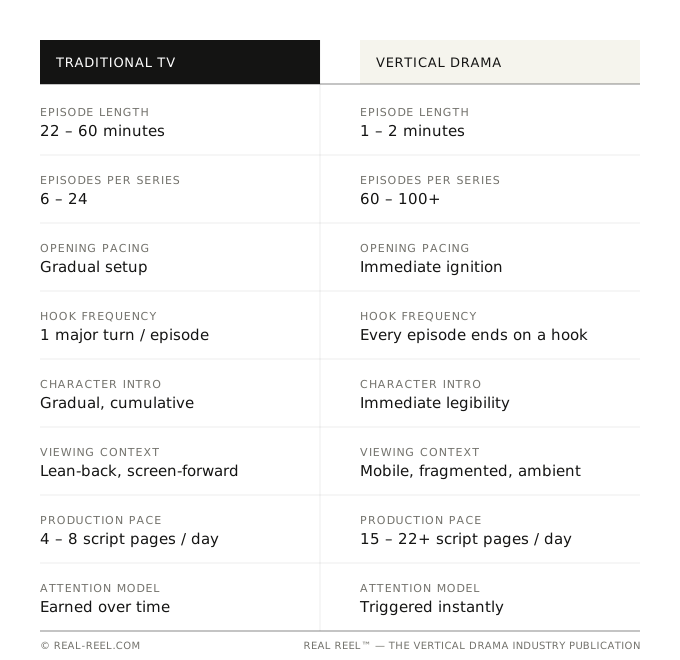
The difference in episode count reflects this logic. A traditional streaming series might tell a complex story across eight to ten hour-long episodes. The same story beats compressed into a vertical drama format might run sixty to one hundred episodes of one to two minutes each. The information density per minute is not dramatically higher. The hook density, the number of cliffhangers, reversals, and emotional escalations per unit of time, is radically different.
In traditional TV: one major plot turn per episode is standard. Two is considered eventful.
In vertical drama: an episode without a hook is a broken episode.
Pacing: Gradual Build vs. Constant Escalation
Traditional storytelling teaches a model of escalation: establish normalcy, introduce disruption, build tension toward a climax, resolve. Even fast-paced genre TV tends to follow this architecture across an episode, a season, or a series. There are peaks and valleys. Breathing room is considered good craft, it lets the audience feel the weight of what has happened before the next thing hits.
Vertical drama does not have valleys. Or more precisely: it cannot afford them.
The pacing model in vertical drama is better described as sustained escalation. Every scene has to be already in motion when the viewer arrives. Every episode has to raise the stakes before it ends. The emotional baseline is high and stays high. There is no "slow second act." There is no quiet scene that earns its place through atmosphere. If a scene is not moving the tension forward, it is, by the format's logic, failing.
This has specific implications for how information is released. Traditional scripts often front-load character context: who is this person, what do they want, why should we care. Vertical scripts invert this. Context is rationed. The audience is dropped into a situation that is already tense, already morally complicated, already moving, and the explanation of why comes later, after the hook has landed.
As Real Reel's Playbook analysis found: "Vertical audiences don't really 'enter' a story. They decide, very quickly, if they're already out."
Real Reel
Character: Depth vs. Readability
Traditional television invests heavily in character interiority. The best prestige drama gives its characters contradictions, histories, blind spots. Character development is slow, cumulative, and often requires multiple episodes before the audience fully understands who someone is. That complexity is part of what makes the format rewarding.
Vertical drama characters are designed for instant readability. Within the first episode — often within the first sixty seconds — a viewer needs to understand what a character wants, what is standing in their way, and what kind of emotional experience they are about to deliver. Subtlety is not the goal. Clarity is.
This does not mean vertical drama characters are shallow. The best ones carry real emotional logic and evolve across a series. But they are built on legible archetypes with clear emotional tags — the wronged woman, the cold CEO with a hidden wound, the villain who is right — rather than on gradual revelation of psychological complexity. The format demands it.
In traditional TV, you discover who a character is across time. In vertical drama, the character's core identity has to be visible immediately, then deepened from there.
The Role of Genre
Traditional television uses genre as a framework — the procedural, the prestige drama, the romantic comedy — but quality productions are expected to transcend or complicate genre conventions. The ambition is often to do something unexpected within a recognizable shape.
Vertical drama uses genre as a delivery mechanism. Genre conventions in vertical drama are not clichés to be subverted. They are promises to be kept. An alpha romance has to deliver alpha romance. A revenge arc has to deliver satisfying escalation. The audience has chosen a genre precisely because they want a specific emotional experience, and deviation from that contract is not interesting — it is a broken promise.
This is why vertical drama's dominant genres — romance, revenge fantasy, CEO drama, supernatural romance — look repetitive from the outside and intensely satisfying from the inside. The genre is not the point. The emotional experience the genre reliably delivers is the point.
Production Logic: Depth vs. Volume
The operational differences between vertical drama and traditional TV production are as significant as the creative ones.
Traditional TV production in the United States typically shoots four to eight pages of script per day. A ten-episode series might take months to produce. Extensive coverage is shot, long editing processes follow, and significant resources go into craft elements — cinematography, sound design, production design — that support immersive viewing on large screens.
Vertical drama production runs on entirely different economics. As John Lewis noted: "In traditional production, shooting five pages in a day is considered strong. On one vertical project I shot recently, we did twenty-two pages in one day."
A vertical drama series of 80 episodes might be shot in a week or two. Budgets are tightly controlled — typically $100,000 to $300,000 per series for U.S. local productions, though this range is increasing as quality standards rise. Visual storytelling is optimized for a small screen: close-ups carry the narrative weight that wide shots and production design carry in traditional TV. The face, specifically the face under emotional pressure, is the primary visual unit of vertical drama.
None of this is a compromise. It is a deliberate design for a different viewing context.
What Happens When the Formats Collide
The industry is currently in the middle of an experiment: traditional TV talent, studios, and platforms entering the vertical drama space.
The results have been instructive. Productions that try to bring traditional TV pacing into vertical formats tend to struggle — slower opening episodes, more deliberate character establishment, and more restrained conflict escalation than the format's audience expects. Wild Silence, the MyDrama series featuring Maksim Chmerkovskiy, drew Real Reel reviewer notes that its "pacing gives the impression that the storytelling rhythm is closer to traditional television drama than to the highly compressed structure usually expected in vertical formats."
This is not a criticism of craft. It is a diagnosis of format mismatch. The skills that make someone excellent at traditional TV do not automatically transfer. The storytelling logic has to be rebuilt, not just accelerated.
The reverse is also true. The best vertical drama creators bring something to the format that traditional TV training does not always produce: an instinct for immediate compulsion, an intolerance for narrative drift, and an understanding that the audience's attention is always in play — never assumed.
A Quick Reference
FAQ
Is vertical drama just TV with shorter episodes?
No. Episode length is the most visible difference, but it reflects a deeper structural divergence. Vertical drama requires different pacing, different hook density, different character architecture, and different production logic. Shortening a traditional TV episode does not produce a vertical drama, it produces a truncated TV episode.
Can traditional TV writers and directors work in vertical drama?
Some adapt quickly. Many find the format counterintuitive at first. The most common issue is importing traditional storytelling habits — slower openings, more patient character work, less aggressive hook frequency — into a format that punishes all of those instincts. The craft skills transfer; the structural logic has to be relearned.
What makes a vertical drama episode "good"?
By the format's own standards: an immediate tension hook in the opening seconds, consistent escalation through the episode, and a cliffhanger or emotional revelation at the end that makes the next episode feel necessary. Quality production values and strong performances matter increasingly as standards rise, but structural compulsion is non-negotiable.
Why do vertical dramas have so many episodes?
Episode count is a function of the format's monetization and retention model. More episodes mean more opportunities for pay-per-unlock revenue and more habit-forming return visits. The 80–100 episode structure is not a storytelling choice. It is an economic architecture that the storytelling is designed to support.
Is traditional TV better than vertical drama?
They are optimized for different things. Traditional TV is built for immersive, sustained engagement with complex narratives and character depth. Vertical drama is built for immediate emotional satisfaction in fragmented mobile contexts. Judging one by the standards of the other produces the wrong answer in both directions.
Real Reel is an independent editorial publication mapping the global vertical drama industry.
For the complete picture of what vertical drama is and how it works:
Real Reel