A line of dialogue that reads fine on the page can still feel wrong on a phone screen — not bad, just slow, a little too explained. That gap points to something real: dialogue in vertical drama is doing a different job than it does in film or television. This piece breaks down what that job actually is, and what it means for how a line gets written.
Every format claims its dialogue works hard. Vertical drama might be the first one where you can't always assume anyone's listening.
A piece of dialogue can read perfectly fine on the page and still feel wrong the moment it's on a phone screen. Not bad, exactly — just slow. A little too explained. A little too much like something from a different format entirely. That gap between "this works on paper" and "this works on the screen" is worth sitting with, because it's not really about length. Something about what a line of dialogue is for has shifted, and it's worth taking apart piece by piece.
A line exists to do a different job now
In film, dialogue has traditionally carried a lot of its weight revealing character — who someone is, underneath what they're saying. In television, across longer arcs, dialogue tends to carry relationships forward — where two people stand with each other, episode over episode. In vertical drama, a line more often exists to trigger what happens next. Not describe the situation. Change it.
That's a shift in the job itself, not just a matter of trimming words, and it produces effects worth noticing on their own.
Watch how an accusation actually gets handled. A slower-paced script might have a character deflect, change the subject, answer something other than what was asked — that hesitation is where a lot of screen time traditionally gets spent. Vertical drama tends to skip it. A character gets accused, and the fastest version of the scene has them naming the accusation out loud before answering it:
"You're cold."
"Cold? Who wouldn't be, watching you hand him everything I built?"
No deflection, no pause, no "I don't know what you mean." The line gets picked up and thrown back with the reason attached in the same breath — which is a different move than simply "shorter dialogue." It's dialogue built to change the shape of the argument immediately, not describe it.
A line rarely needs to state what a close-up has already shown, either. Vertical drama leans hard on tight shots — a face fills most of the frame for a large share of any given scene, and the audience has already read the fear or the fury off it before anyone speaks. A line that follows up with "I'm scared" is doing work the camera just finished doing. The line has room to do something else instead — not describe the fear, but decide what to do about it. "Don't come closer" carries the same fear and gives the audience new ground to stand on.
And a long, uninterrupted speech struggles to trigger anything, because nothing about the situation moves until the speech ends — by which point the moment that needed changing has usually passed. This may be part of why interruption shows up so often in this format. A line cut off mid-sentence is a small transfer of power in itself — someone loses the floor, someone else takes it — and that transfer does the triggering a full, uninterrupted sentence often can't:
"I never wanted—"
"Then why did you sign it?"
Neither line is a complete thought. Together they move the scene somewhere a finished paragraph wouldn't have.
A picture, not a report on how someone feels
A related pattern: vertical dialogue tends to reach for a specific object or action before it reaches for an abstract feeling. "I forgive you" is a statement about an internal state — true or not, the audience has to take the character's word for it. "Keep the ring" is a decision made visible; there's a specific thing in the world that now means something it didn't a second ago.
This connects back to the triggering logic above: a concrete image gives the audience something to react to immediately, in a way an abstract emotional claim doesn't. "I still love you" asks to be believed. "I never deleted your number" hands the audience a fact and lets them do the arithmetic themselves — which tends to land harder than being told the conclusion directly.
Worth being careful here, though: none of this means the emotional complexity underneath a scene disappears. It's often just relocated. Say a character has just been humiliated in front of people whose opinion matters to her, and someone asks if she's all right. "I'm fine." She's not fine, and everyone watching knows it — but in a slower format, that gap between the word and the truth might live in a pause, in what she doesn't say next, in a beat of silence before someone calls it. Vertical drama usually doesn't have room to spend on that beat. So the gap goes into the action line instead — her hand isn't quite steady on the table, or she says it already turning away so no one has to watch her face not mean it. The dialogue stays flat. The contradiction lives entirely in what she's doing while she says it. The subtext hasn't been cut — it's just not sitting inside the quotation marks anymore.
A line that might be read as often as it's heard
Look at how these platforms describe themselves, and a pattern shows up across nearly all of them independently: your commute. Lunch break. Winding down at night. Scrolling under the blanket. None of those are scenes where sound is necessarily on. And across these apps, subtitles aren't tucked away as an accessibility afterthought — they're marketed as a headline feature, sometimes in nine or more languages, explicitly framed as helping the audience keep up when dialogue moves fast.
None of that adds up to proof that most viewers watch with the sound off — that's not a number anyone has published, and it would be overstating things to claim it as settled fact. But it's a reasonable enough pattern to hold in mind while writing: a line in this format may be read as often as it's heard, and it's worth asking, at least sometimes, whether a piece of dialogue still works if the audience only ever sees it as text.
If that's a live possibility, it adds a second explanation for why the direct, image-forward dialogue above works as well as it does here — a line that doesn't lean on tone or delivery to land its meaning survives the trip from spoken to read without losing much. That may not be the only reason those patterns show up so often in vertical drama, but it's one worth keeping in the back of your mind.
Voiceover in a format that might not have the sound on
The general rule still holds: if a line can be delivered as dialogue between two people, it almost always should be — a scene with friction between two characters is more watchable than a voice narrating over a static shot, and it usually accomplishes the same informational work. A common failure mode: a writer wants the audience to know a character just came back after years away, and defaults to a VO line like "It had been years since she'd set foot in this house." The fix is almost always to route the same information through friction between two people instead — someone opens the door and says "Years, and you didn't call first?" Same fact lands, but now it's carrying a relationship too, for free.
Worth considering on top of that: voiceover depends entirely on sound to land. Dialogue delivered on screen gets a second life as text even if the audio is off. A voiceover line, without accompanying subtitles, may simply not reach part of the audience at all. That's speculative — nobody has published data connecting the two — but it may be part of what's underneath the instinct, common across this kind of writing, to treat VO as a last resort rather than a default: it's the one tool in the format that can't fall back on being read.
When VO does earn its place, two patterns show up often enough to be worth recognizing. One is a composed, controlled line spoken aloud, immediately followed by the private truth underneath it — a character says "I'm fine," flat and believable, and the VO that follows is the sentence she'd never say to anyone's face. The other is closer to a private vow — a line of resolve or anticipation dropped in right before a reversal, giving the audience something the other characters in the scene don't have yet. Neither is a formula to apply mechanically. They're patterns worth checking a VO line against: if it could survive being said to someone else in the scene, it probably shouldn't be VO. VO earns its place when the whole point is that no one else can hear it.
How a line breaks across the screen changes how it lands
One more thing worth noticing, separate from what a line says: how it's broken up on screen changes its weight. The same sentence, delivered as one unbroken block versus split across two or three short beats, doesn't land the same way.
I knew about everything.
versus
I knew.
About everything.
Same information. Different pause, different weight on the reveal. This isn't a formula to apply to every line — most dialogue doesn't need this kind of engineering — but it's worth remembering that in this format, the line break is doing some of the work a pause or a breath would do in performance.
A test you can run yourself
Before locking a scene, try watching it with the sound off. Not because every line needs to survive that test on its own — some genuinely don't need to — but because it's a fast way to check whether the scene's power dynamics are legible without tone of voice doing the explaining. Can you tell who's losing ground and who's gaining it? Is there a moment where the only way to understand what just happened is by hearing how a line was delivered? That's not automatically a mistake, but it's worth knowing it's there.
Making a line sound like someone, not just information
Separate from all of the above: dialogue still has to sound like a specific person, not a name tag doing the work. Try the swap test. If a rival CEO and a jealous ex could trade this line and it would still fit either of them —
"You think this ends the way you want it to?"
— that line hasn't found a voice yet. Compare it to something built for one person: the CEO who never raises his voice says "I don't threaten. I schedule." The ex, cornered, says "You don't get to be calm right now." Same beat, neither line survives being handed to the other character.
Further Reading:
- The pacing framework behind vertical episodes — including the same mute-test logic applied to structure instead of dialogue: "If the jolt disappears when you mute the audio, it wasn't a jolt. It was volume."
 Real Reel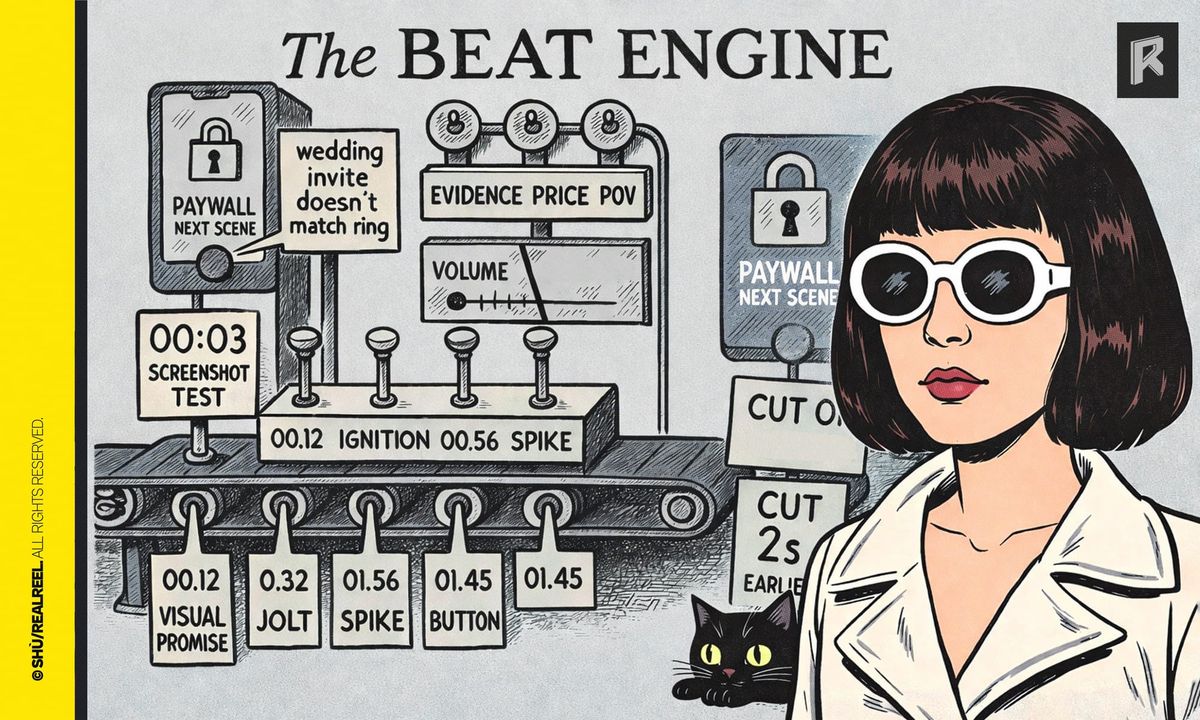
- A framework for building characters who read as distinct before they open their mouth — the character-level counterpart to the voice-differentiation work covered here.
 Real Reel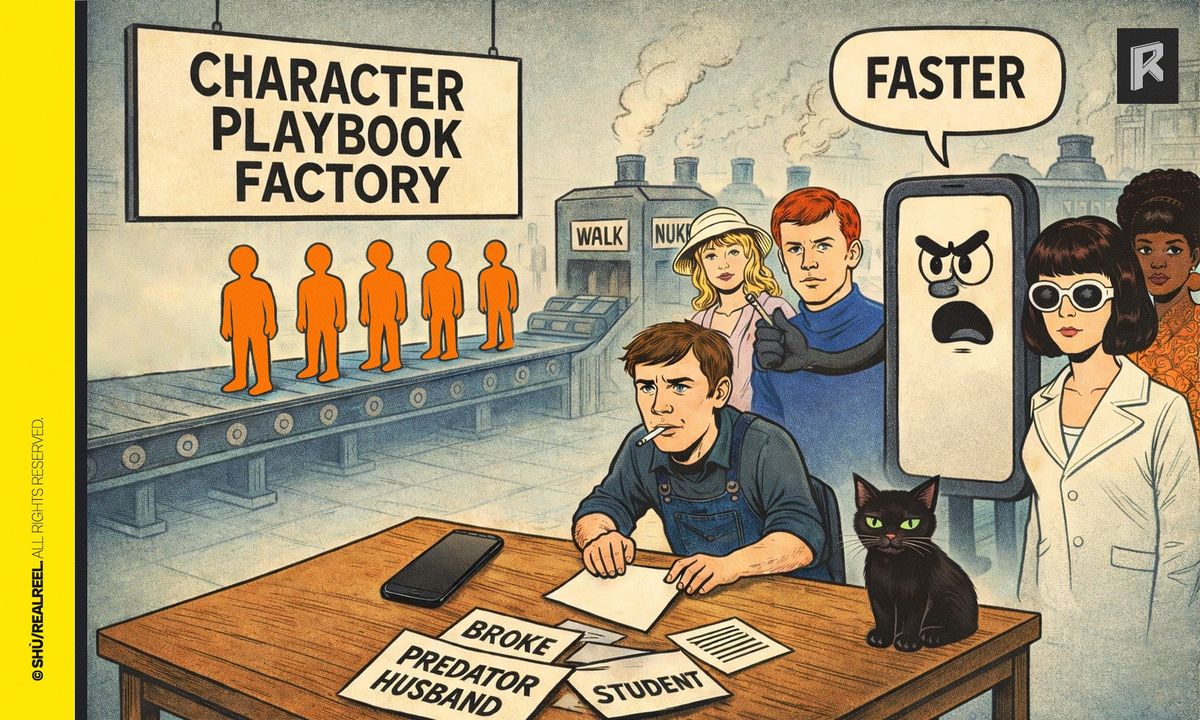
Real Reel Playbook covers the craft and structure of vertical drama for creators who take the format seriously.